What happens if we rely solely on the GPS for navigation?
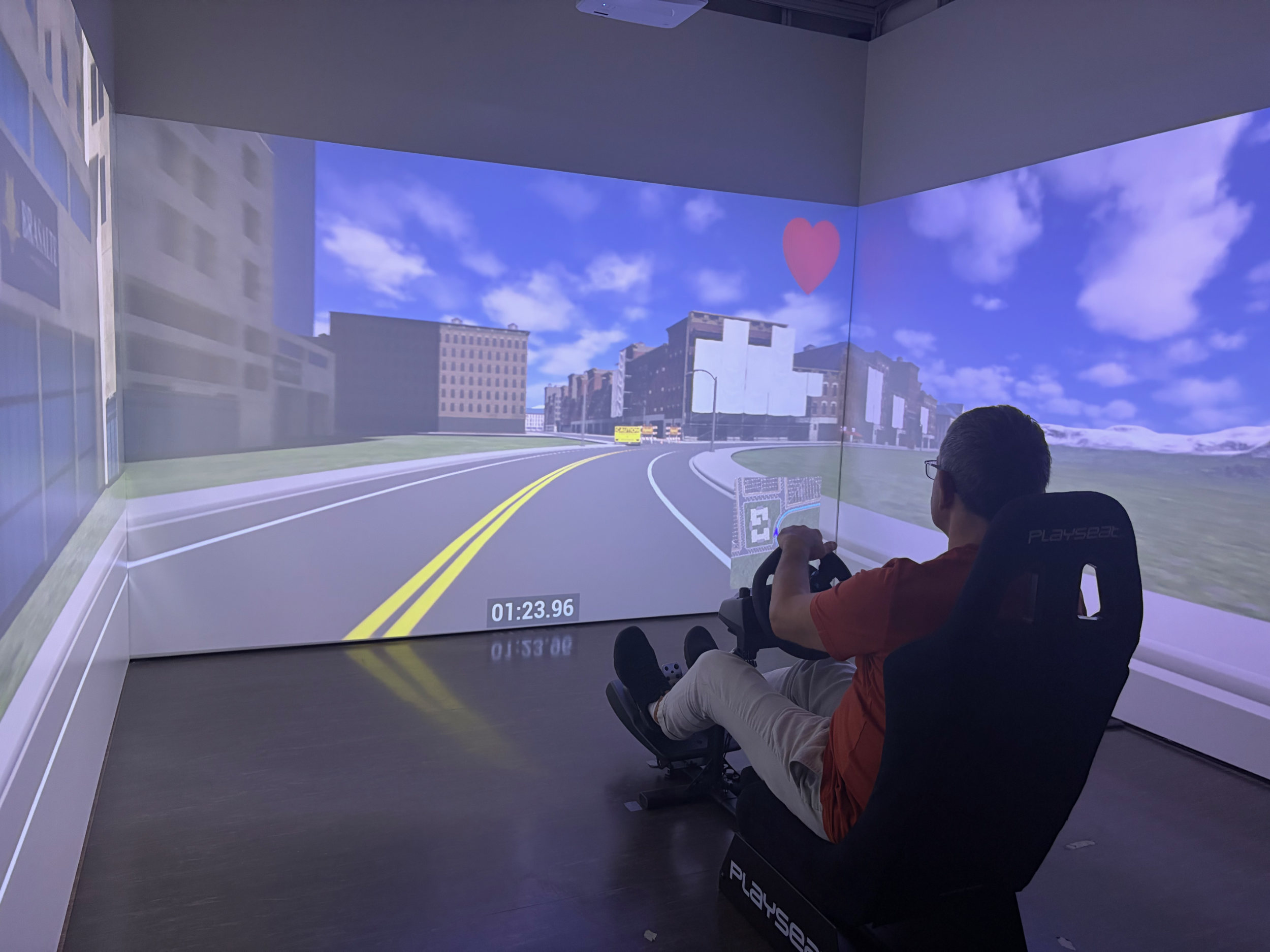
How does continuous dependence on navigation systems affect our sense of direction? What does this mean for our ability to learn about geographical space? See for yourself what happens when you drive through a virtual city in a driving simulator.
When you navigate a city – whether on foot, by bike, or by car. – you’re not just looking for the way. You’re also getting to know the structure of its space and storing reference points, landmarks, distances, and directions in what’s known as a cognitive map.
The “Geographic Information Visualization and Analysis” research group works at the intersection of geography, cognitive science, and human behaviour. One of our central research questions is: How do people form mental representations of the spaces they move through? Or, more specifically: How well can we actually find our way around without Google Maps?
Our aim is to understand the learning process for developing a sense of geographical space, what factors support this process, and how does stress, distraction, or sensory overload affect it. This understanding has direct implications for the design of cities and navigation technologies.
We investigate this under controlled conditions in experiments, using virtual environments that simulate real-world movement (e.g., walking, cycling, driving). In this virtual reality, we can precisely control what participants experience, replicate the conditions for different subjects, and measure their physiological and behavioural responses – all without exposing them to dangerous traffic or bad weather.
We simulate navigating a virtual city – which we project onto three screens – using a driving simulator equipped with a steering wheel, acceleration and brake pedal.
Finally, we use a photoplethysmography sensor to measure changes in heart rate. We use heart rate as a physiological indicator of stress and cognitive load. As navigation becomes more challenging, we expect to see an increase in heart rate. Try out the driving simulator yourself and find out, what happens to your body and your behaviour.